Description Meta
Netflix’s Remarkably Bright Creatures mixes grief, healing and unlikely friendships between a grieving woman, a drifter and a wise octopus.
Introduction: A Story of Quiet Kindness
Netflix’s Remarkably Bright Creatures (2026) isn’t the type of drama to try and bedazzle you with twists or loud emotional peaks. Its pace, instead, is patient, as if it takes a close look at its characters before it speaks of them.
Based on the best-selling novel of the same name, the movie weaves together three very different lives: an older woman dealing with profound personal loss, a young man trying to find his way again, and an octopus who observes it all quietly behind glass.
It’s simple on the surface, but layered emotionally underneath.
A story that breathes, not rushes
The first thing that strikes you is the leisurely pace of the storytelling. The film grants you moments of sitting without interruption. Talks last a little longer than they should. Silence is not used as void, but enters the dialogue itself.
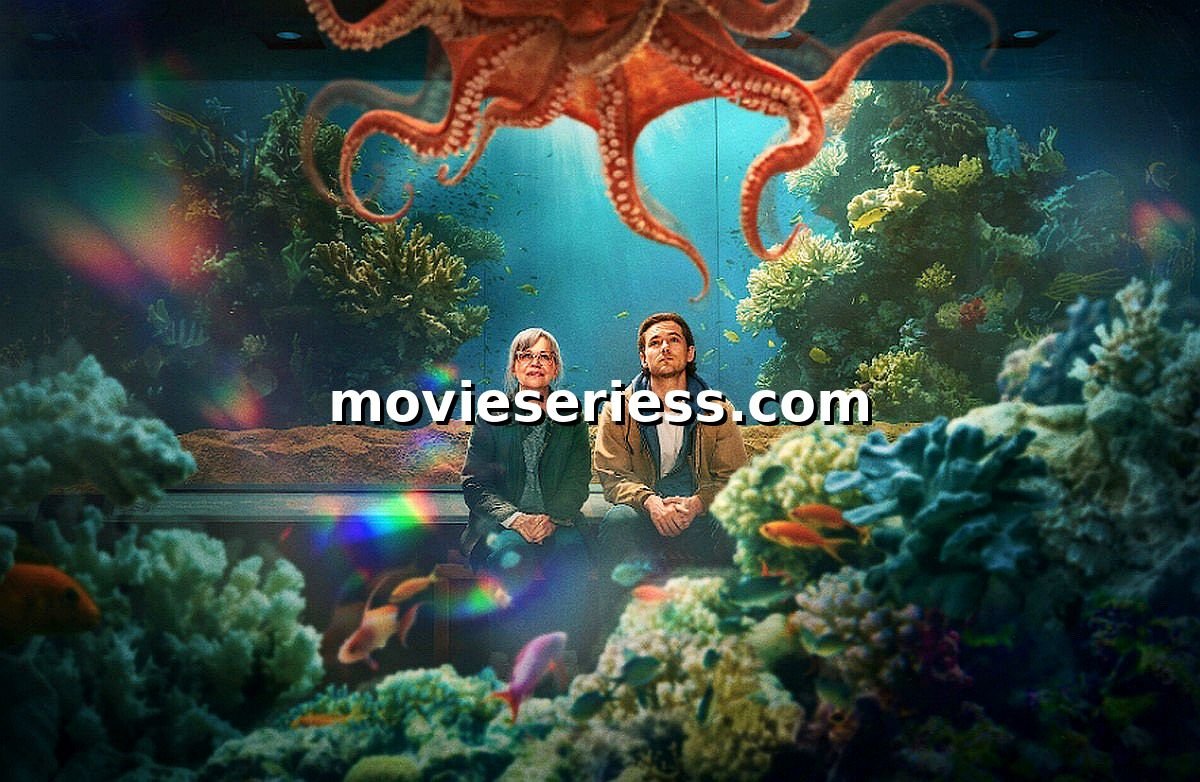
The movie takes place in a small coastal town, and builds its emotional heft through the rhythms of ordinary life, not through dramatic events. The aquarium is the main gathering place, the place where human struggle and quiet observation come together.
Tova: Living In Silence With Grief
Tova, an older woman who works as a cleaner at the local aquarium, is the story’s focus. She bears the great absence of her son, a loss that has changed her relationship to the world.
Tova has withdrawn into a controlled, private life rather than show her pain openly. She avoids unnecessary social contact, especially with those who tend to gossip or misinterpret her silence. But there is a constant tension between strength and vulnerability under the poise.
Her daily ritual with the sea creatures, especially the octopus Marcellus, becomes a subtle emotional release that she does not consciously acknowledge but on which she heavily depends.
Cameron: Trying to find a path in a messy life
Cameron is coming from a very different place in the narrative. He’s in town looking for answers about his father, his camping van is broken down and debts are mounting. All the while dealing with financial stress.
He is not depicted as a great hero or a lost genius, just a young man trying to stay afloat. The temporary job at the aquarium moves from being a plan to a necessity.
Over time, Cameron’s relationship with Tova moves from the casual exchanges of the workplace to something more grounded and meaningful. Their bond is built on shared silences and small talk and an unexpected sense of understanding.
Their age difference, based on shared loneliness and subtle strength, doesn’t feel contrived, but organic.
Marcellus: The Spectator Behind the Glass
Marcellus is an old octopus who resides in the aquarium tank, which is one of the most peculiar elements of the film. He cannot speak but his point of view is used as a narrative device that looks at human behavior with surprising clarity.
Marcellus becomes a silent commentator on the emotional distances that separate people. He watches, he studies, and he creates his own understanding of the humans around him, most especially of Tova and Cameron.
And he gives the story a philosophical dimension. His emotions are often refracted through his observations rather than laid out explicitly, making the audience think rather than just react.
The Power of Atmosphere and Stillness
One of the film’s most powerful creative decisions is its pace. Pauses are deliberate. They stretch out the silence to explain to the audience the emotional weight between them.
This feeling is compounded by the rural location. The quiet streets, the calm interiors, the steady routines all offer a sense of emotional containment. There is no sense of haste, and that holding back becomes part of the storytelling identity.
The aquarium scenes are the most visually stunning. The underwater environment is a beautiful contrast to the grounded reality of the town, adding a subtle layer of visual poetry.
Character Dynamics & Emotionality
What makes Remarkably Bright Creatures work is not its complex plot, but the way its characters embody different kinds of loneliness.
Tova is grief internalized, tightly managed but never resolved. Cameron is a personification of uncertainty and survival, always responding to unforeseen circumstances. Marcellus, however, stands apart, a spectator who knows more than he can utter.
They form a strange emotional triangle in which the link develops without any dramatic confrontation. It is instead slowly grown through shared existence.
Final Thoughts: A film that feels like a reflection
Remarkably Bright Creatures is more about emotional recognition than events. It’s about what people don’t say and how sometimes silence can be more telling than words.
The film is not about shocking its audience with surprise or twist. Instead, it reflects on grief, acceptance and the subtle ways people start to heal without really knowing it.
Summary
It’s a restrained, emotionally considered drama that works through coolness rather than heat. The pace may seem slow to lovers of traditional storytelling, but the emotional honesty and atmospheric depth is memorable.
Ultimately, Remarkably Bright Creatures is best as a quiet viewing experience that reverberates quietly once it’s over.