Meta Description:
Yeon Sang-ho’s “Colony” adds a new twist to the zombie horror genre with psychic infected, gripping survival drama and a riveting first half that loses steam later.
Intro
South Korean horror has a reputation for taking familiar genres into darker, weirder territory, and Colony continues that tradition confidently. Directed by Yeon Sang-ho, the film comes with big expectations. This is the filmmaker who helped redefine modern zombie cinema with Train to Busan.
Luckily Colony doesn’t try to copy that success.
This isn’t another high-speed survival thriller on a moving train; this film locks its characters inside a hulking commercial complex where paranoia spreads as fast as the infection. The result is a horror movie that’s grotesque, claustrophobic, and unexpectedly ambitious. It works very well for most of its running time.
The trouble is that the more the film explores its own mythology, the more the storytelling falls apart.
Shared Consciousness Zombie Outbreak
The main character of the story is Dr. Kwon Se-jeong, who we meet at a biotech conference at Chains Bio. A typical corporate science get-together quickly becomes a disaster when a disgruntled researcher unleashes a virus inside the building.
Colony, though, isn’t about traditional zombies.
The infected here mutate rapidly, communicating through some kind of telepathic link. They are erratic, they are organized, and they are scary-smart. That alone is sufficient to give the movie a new identity in an overpopulated horror genre. The survivors can’t just run from the monsters or barricade the doors. The infected keep evolving so every strategy is temporary.
The film is most successful in that constant state of uncertainty.
The Dongwoori Building is packed as well, which adds another layer of tension. Hallways turn into death traps. Floors of offices turn into hunting grounds. Scary elevators. Yeon Sang-ho knows how to transform everyday architecture into nightmare fuel, and he squeezes every bit of anxiety out of the setting.
Keeping the Panic Human: The Film’s Cast
One of the best things about Colony is how invested the audience is with its survivors. The cast is full of familiar Korean faces, but the film is smart enough to not let anyone feel entirely secure.
Jun Ji-hyun plays Dr. Kwon Se-jeong, whose emotional detachment helps to ground the increasingly surreal goings-on around her. Meanwhile Ji Chang-wook and Kim Shin-rok do a lot of the emotional heavy lifting, based on a relationship of loyalty and desperation.
And then there is Koo Kyo-hwan, who steals several scenes with his chaotic energy and sharp reactions to the crumbling situation around him. His performance adds personality to the group dynamic, even in the film’s darkest moments.
The film also plays cleverly on audience expectations. Korean horror leads don’t have much of a guarantee of survival, and Colony uses that fluidity well. Here big name actors don’t automatically get heroic protection. Several sequences really suspenseful because of that uncertainty.
Horror Imagery That Feels Uncomfortably Alive
Colony is totally committed to its disturbing visual aesthetic.
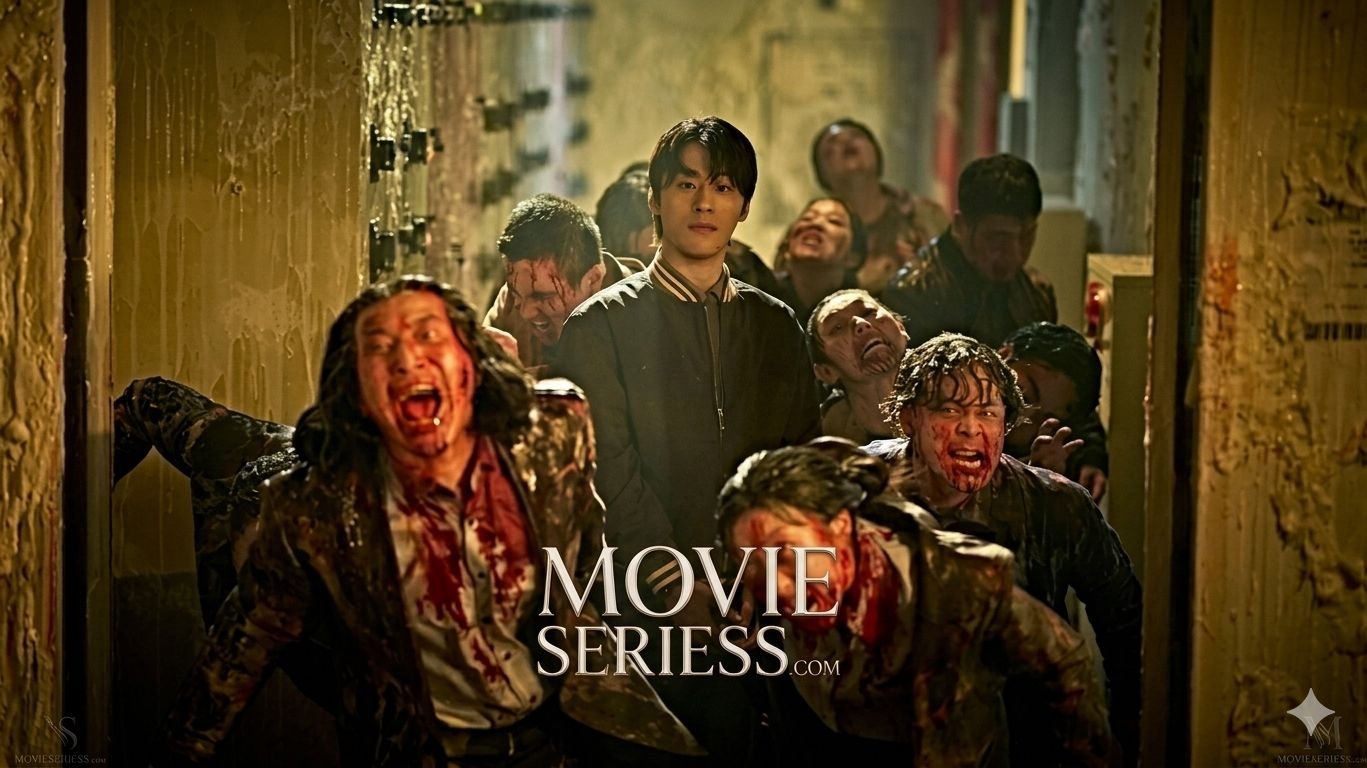
The infected are coated in a pale slime, blank-eyed, grotesque, almost like parasitic creatures rather than normal zombies. The production design slowly turns the office building into a living biological nightmare. Walls get contaminated. The corridors seem infected too. By the middle, the setting no longer feels like a place of work, but rather like a dying creature that devours all those caught within it.
Practical gore and creature effects work well to maintain the horror atmosphere. Everything looks unsterilized. The movie wants you to feel trapped in a filthy, collapsing ecosystem. And it does.
There’s also a disturbing body-horror element that sets it apart from more action-heavy zombie movies. At times Colony feels more like psychological sci-fi horror than just straightforward apocalypse entertainment.
When The Script Starts to Fall Apart
Despite its innovation, Colony stumbles on the narrative front in the second half of the film.
The pacing is relentless once the outbreak begins, even though the first act is weighed down by exposition. Unfortunately the script tries to force conflict later on rather than letting the tension build naturally.
Some character choices stop making sense. Survivors suddenly forget everything they knew about the infected, making infuriatingly preventable mistakes. Some of the conflicts are so manufactured just for the drama, rather than a natural evolution of the situation.
And two side characters in particular become huge weak points. The aggressive bully and the panicked policeman. Their character arcs are written with almost no nuance and the film bends logic over and over to justify what they do. They don’t add complexity, they take momentum away from the survival story.
This is all the more disappointing because the premise of the movie is good enough to carry the movie without all the unnecessary craziness.
Colony shines brightest when it leans into survival horror
Oddly, some of the least interesting scenes take place outside the quarantined building.
At times the movie edges toward research around the virus and attempts to explain the origins of the virus in more detail. These scenes do expand the world but also break the intense atmosphere that makes the movie effective in the first place.
The most effective sequences are still the simplest: frightened survivors wandering dark hallways trying to outsmart the ever-changing infected creatures.
This stripped-down survival approach is Colony’s comfort zone.
Conclusion
It may not quite reach the emotional accuracy or narrative consistency of Train to Busan, but Colony still makes a case for itself as one of the more inventive zombie horror films of recent years.
The movie scores points for not recycling tired apocalypse tropes. Its psychic infected setting, oppressive atmosphere, disturbing creature design and unpredictable cast dynamics make for a truly memorable horror experience. The atmosphere is enough to keep people interested, even when the writing gets messy.
If the screenplay had retained the same smarts and control that it exhibited in the first half, Colony could’ve been an all-time modern K-horror classic.
It just falls short of great – ambitious, scary, visually stunning, but uneven in the end.
But for horror fans looking for something nastier and more experimental than the average zombie movie, Colony is certainly worth the ride.