Meta Description:
Zero Parades: For Dead Spies is a tense spy RPG with great political tension, sharp writing and bold ideas, but uneven pacing.
- Introduction
There are no comparisons to make. The second ZERO PARADES: If you’ve played narrative-heavy RPGs, you’ll notice echoes of Disco Elysium right from the start of Dead Spies. The broken hero. The ideological mess. The mountain of talk. The corpse-adjacent mystery that gets it all started.
But to write off this game as another ZA/UM cult masterpiece copycat would be doing it a disservice.
Inside, Portofiro is stranger, more rough, more experimental in many ways. It trades detective noir for espionage paranoia, covering political rot with time sensitive missions and psychological systems that keep the player always looking ahead.
It doesn’t always land the landing. Sometimes it falls on its face. But even at its most messy, there’s something interesting about what it’s trying to do.
Portofiro Takes the Show Away Really
The fictional district of Portofiro feels less like a setting, and more like a living ideological battleground.
This old prison colony, upgraded through EMTERR’s so-called stabilization efforts, is a city awash with surveillance infrastructure, knotted wires, flickering screens, and social unrest. Beneath the surface, there is tension simmering everywhere you look.
It was a place where every alley seemed watched, every word weighted, where even the city’s absurdities – like the strangest TV prophet Bagman ranting beneath a paper bag – somehow added to the atmosphere rather than broke it.
The world-building is dense, but it doesn’t deaden things. It captures that specific brand of Eastern European political melancholy: a society caught between failed ideals and oppressive modernization.
Frankly, Portofiro could be one of the strongest RPG settings of the year.
Hershel’s Story Adds Emotional Weight to the Mayhem
Hershel, code name CASCADE, is at the heart of this political maze.
She wakes up to find her partner, Pseudopod, out of commission under very suspicious circumstances and there is a strange red disk that seems to be involved.
That mystery would be sufficient to carry the story, but the game wisely adds complexity by rooting everything in Hershel’s unresolved trauma.
Five years ago she had led the disastrously named Whole Sick Crew into battle and the fallout from that mission still hangs over her every decision. Her return to field work at the request of operator Mel seems less a heroic comeback than a desperate grab for redemption.
This emotional baggage gives the game a much needed human core.
Hershel is not a slick super-spy. She’s a mess, uncertain, often bitter, and all the more interesting for it.
Opening Hours Nearly Sink the Experience
Here is where the game shoots itself in the foot.
Zero Parades is a great book, but it begins with an avalanche of exposition that borders on self-sabotage.
The first game is bogged down with overly lengthy explanations of its political systems, backstory, organizations, and terminology rather than trusting players to get the world naturally.
There’s a particularly clumsy information dump involving a folder in Hershel’s apartment that practically screams: Here is everything you need to know.
It’s like you’re given a homework assignment before the story even starts.
That’s a shame because when the game finally loosens up and lets you explore, investigate and piece things together organically it becomes so much more engaging.
Patience is rewarded here – but some players may bounce off long before that point.
RPG Systems That Are Accessible, Sometimes Too Accessible
The game’s role-playing framework is divided into three broad disciplines:
Ability to take action
Focuses on physical ability and reflex-based problem solving.
Traits of Relationship-Oriented
Specialized in persuasion, manipulation, emotional reading.
Intellectual Abilities
For logic, analysis and technical interactions.
It provides character building for the common man, especially for players new to dialogue-heavy RPGs.
But that access comes at a price.
The depth here feels a lot thinner than genre heavyweights like Baldur’s Gate 3 or Tyranny.
Yes, you can influence Hershel’s approach, but rarely to the extent that it radically changes the roleplay possibilities.
It’s enough to back meaningful choices, but not enough to support the wildly divergent builds genre fans might hope for.
The best mechanic is the least used mechanic.
There are a number of great ideas in the game, but one really shines: Dramatic Encounters.
These sequences slow down time in moments of high pressure and force the players to make snap decisions based on skill.
Less action combat, more psychological chess match.
A narrow escape from danger or a hair-raising confrontation, these moments give real urgency to an otherwise talky experience.
The catch?
They don’t suffice.
Whenever one does show up, the game seems to wake up suddenly and reveal what it could have been with more confidence in its systems.
Some more of these sequences could have greatly improved the pacing.
Time management causes tension — and frustration
One of the most daring systems in the game is its relationship to time.
NPCs have schedules. Missions take place at different times of the day. Conversations last minutes.
This creates a great sense of pressure once players understand how it all fits together.
It’s oddly satisfying planning your route through Portofiro, syncing up multi-nighttime objectives, and optimizing dialogue choices.
But there is a catch.
The game often fails to communicate key scheduling information clearly.
At times it appears less of a strategy and more of a blind trial and error.
Some objectives are frustratingly opaque without an appropriate wait system, or transparent scheduling cues.
That’s a smart move.
Execution required a bit more finesse.
sharp, funny and sometimes over the top writing
The dialogue is the most consistently strong aspect of Zero Parades.
The humor lands more than it doesn’t, balancing the game’s oppressive politics with absurdist charm. Hershel’s conversations can jump from deep introspection to hilariously inappropriate in seconds.
There are some really great lines throughout the game.
That said, the script can sometimes indulge in profanity.
Strong language isn’t a problem per se — it often suits the world — but that almost every character seems tuned to the same verbal frequency.
When all sound equally aggressive, character distinction is dulled.
Still, it’s a well-written RPG overall, and the story twists late in the game reward players who keep with it.
Presentation Sells Dystopian Feeling
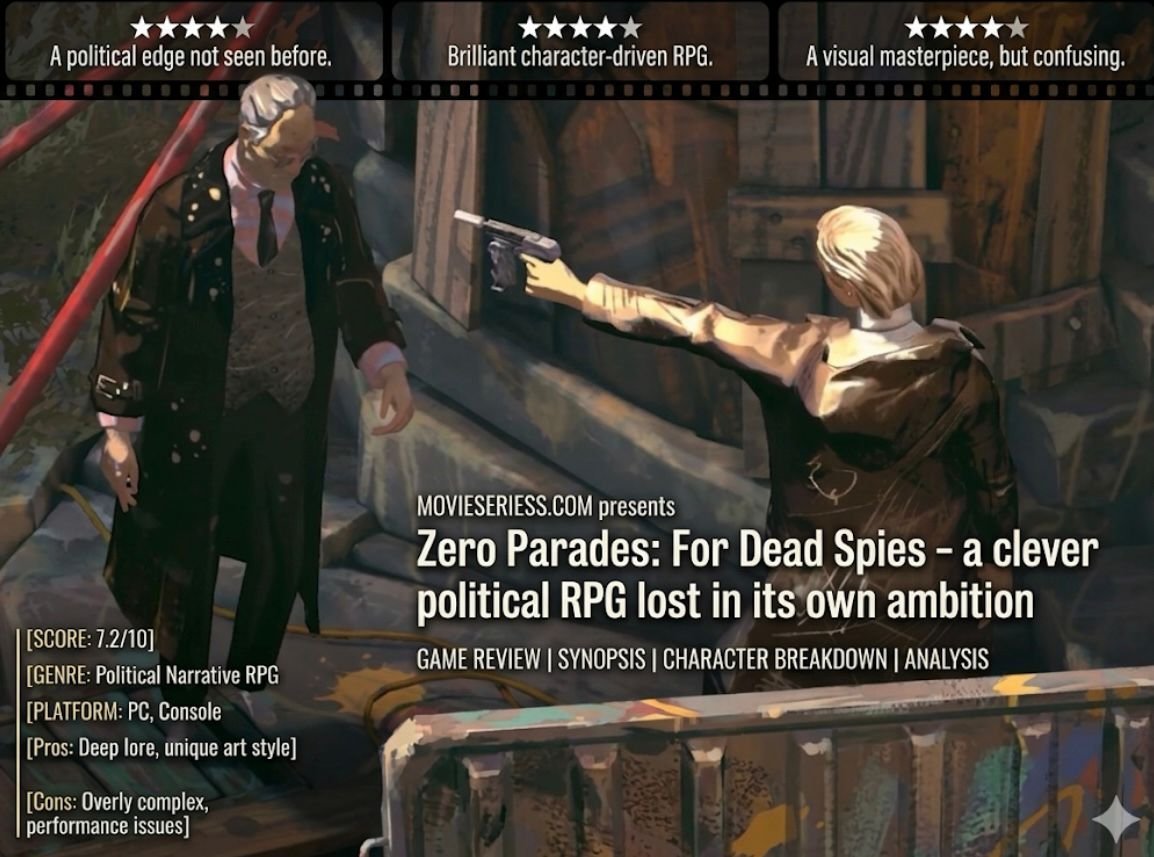
The hand-painted aesthetic hits you immediately visually.
No, it doesn’t quite reach the painterly heights of Disco Elysium, but Portofiro is distinctive enough to stand on its own.
The lighting, the cluttered interiors, the strange architecture and the decaying urban spaces all help to underscore the suffocating atmosphere of the city.
Also commendable is the sound design.
Ambient noise provides a subtle undercurrent of unease, never overpowering the quieter moments, and Hershel’s voice performance gives her personality real texture.
It’s a low-key but effective production.
What Works and What Doesn’t
When the game trusts in its setting, its mystery, its weird personality, it works.
It falls down when it over-explain itself, or when it slows to a crawl with endless errands.
That unevenness is the whole experience.
At its best this is one of the more interesting narrative RPGs to come out recently.
At its worst it’s a marvellous prototype for an even better sequel.
Final Verdict
ZERO PARADES: Dead Spies is ambitious, intelligent, and weird in a way that feels fresh.
It never quite shakes off the shadow of the games it will inevitably be compared to, but it deserves respect for forging its own identity with political intrigue, experimental systems, and a deeply atmospheric world.
Yes, its rhythm falters. Yeah some of the mechanics feel a little underdeveloped. And yes, curbs on the opening hours were desperately needed.
But under those faults is a memorable spy RPG filled with sharp ideas and replayability for multiple tours of Portofiro.
Rating: 7.8/10
A flawed but fascinating espionage RPG that rewards patience with one of the most distinctive narrative worlds of the year.