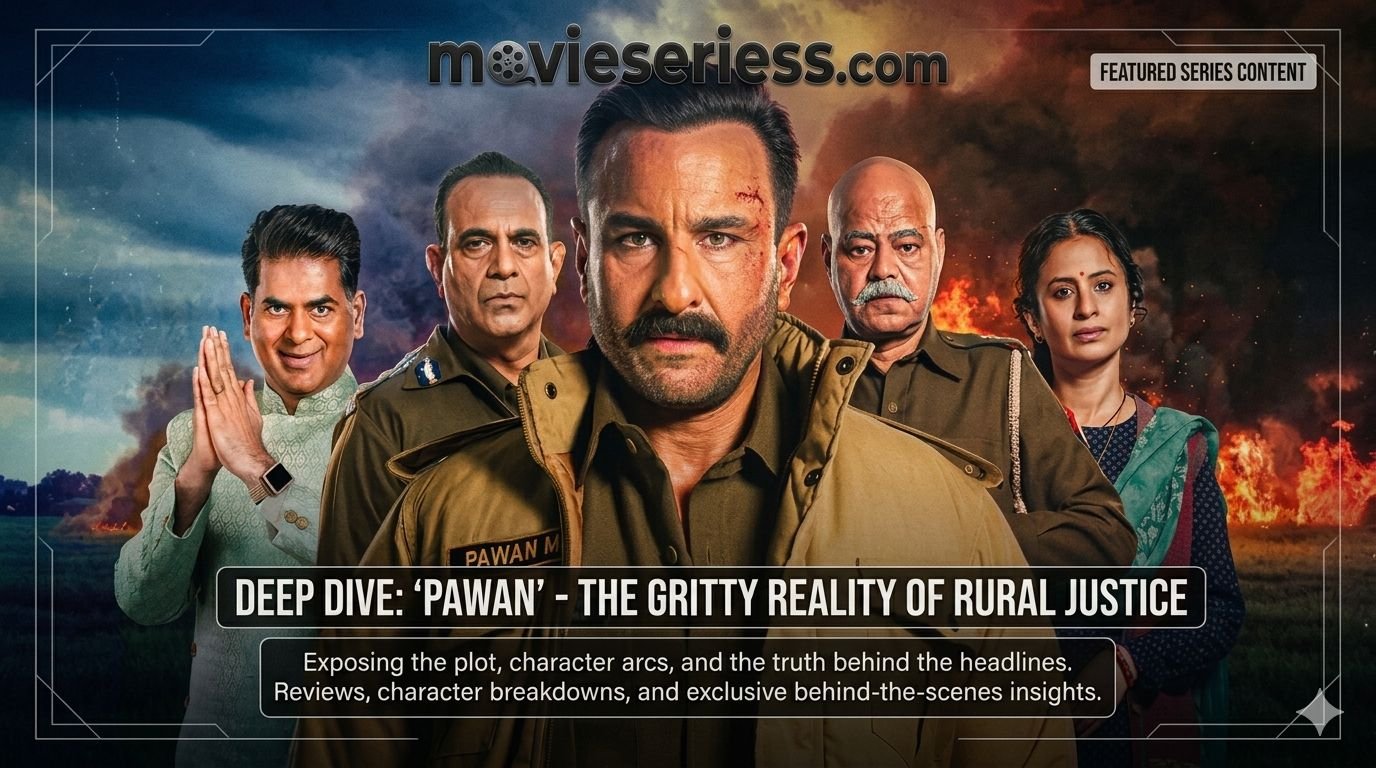
Meta Description:
Netflix’s Kartavya is a taut social drama which weaves together honour killings, child labour and moral conflict in a taut tale, where Saif Ali Khan turns in a powerhouse performance.
Introduction
Some movies are fun. Some leave you sitting in silence long after the credits have rolled.
Netflix’s Kartavya falls squarely in the second category. This Indian social drama for 2026 doesn’t need overblown action or melodrama to make its point. Instead, it gradually increases the pressure, compelling the audience to face the harsh realities of systemic injustice through the perspective of a man torn between personal loyalty and professional duty.
Kartavya is not about crime; it’s about conscience at its core. It poses a profoundly awkward question: what do you do when the right thing means you have to go against your own people?
The film is an intimate, tense and emotionally layered take on familiar themes of corruption and social oppression. Saif Ali Khan gives one of his most restrained performances in recent years.
A Town of Secrets
Jhamli is a made-up rural town that will never appear on any map, but everything it stands for seems painfully real.
The film covers seven tense days, starting on SHO Pawan’s birthday – a symbolic opening that subtly hints at the personal reckoning to follow. Pawan is a police officer who still believes in procedure, fairness and the system itself.
That faith is tested almost immediately.
He’s been assigned to protect a journalist investigating allegations of illegal child labor tied to a respected local reform leader. Meanwhile, crisis erupts in his own family as his younger brother’s intercaste marriage prompts a violent backlash from townspeople intent on enforcing tradition through bloodshed.
It is in this dual narrative that Kartavya finds its strongest footing.
Rather than showing social injustice as a problem far away, the story collapses social duty and private pain in the same suffocating space. Pawan is not only fighting as an officer for justice – he’s fighting for the survival of his own family.
Saif Ali Khan’s Quietly Commanding Performance
Saif Ali Khan has played conflicted men before, but there’s something particularly grounded in his work here.
No such theatrical grandstanding. No pompous speeches. His Pawan is all restraint – subtle gestures, long silences, the slow physical tiredness of a man carrying too much.
His inner conflict feels so real, that’s what grounds the performance.
Pawan is not drawn as a larger than life hero. He falters, he falters, and he can be maddeningly passive at times. But that’s what makes him interesting. He feels like a real person trapped by circumstance, not a cinematic savior.
His constant references to the Mahabharata are not literary frills. They mirror his mind, particularly his analogies to Arjun’s impossible decisions and the imagery of the Chakravyuh, a moral entrapment.
It’s a neat thematic layer, adding philosophical depth to the character without being preachy.
The emotional backbone is in place
The social issues drive the plot and Pawan’s broken household generates the emotional tension.
Rasika Duggal lends a warmth and quiet strength to the role of Pawan’s wife. Her character could have easily been reduced to a supportive spouse archetype but the film gives her enough emotional nuance to feel essential.
She is another type of resilience – one who works within limiting traditions, and yet pushes against them in small but significant ways.
Then there’s Pawan’s father, a paragon of that rigid worldview the film rails against as a kind of generational resistance.
Their conflicts never feel exaggerated, because they are rooted in a reality many families still face: the painful collision between changing values and inherited social codes.
Suspicion About Ashok Changes Everything
From the moment Ashok enters the narrative there is something deliberately wrong about him.
The film subtly hints at its plot twists instead of revealing them outright. His aloofness seems at first like indifference, but as things develop, that feeling becomes a suspicion.
One of the film’s understated effective moments is when his pretense of dependence on an arm crutch is exposed.
It’s not a big secret. Instead, it lands with chilling precision, forcing both Pawan and the audience to rethink everything.
That subtle reveal is emblematic of Kartavya’s larger storytelling style: it depends on viewers to observe, ponder and come to conclusions.
Visual Storytelling That Talks Loudly
One of the film’s most underappreciated strengths is the use of lighting and atmosphere.
The camera work is in tune with Pawan’s descent into insanity. Uncertainty scenes rely heavily on muted shadows and dimly lit interiors, while moments of hope are filmed with natural light and open spaces.
It’s a visual language that gently underlines the emotional rhythm of the film.
Likewise, it is refreshing that there is no intrusive musical numbers or manipulative background scoring.
The soundtrack knows when to hold back.
Kartavya shows restraint in a genre that tends to overplay emotional cues, letting tension arise naturally from performance and situation.
The Film’s Missteps on Social Commentary
Many issue-driven dramas fail because of the weight of their own messaging.
They turn into lectures, not stories.
Kartavya largely avoids that trap, because it doesn’t over-explain itself. It shows child labour, caste violence and institutional compromise as realities of life, not convenient plot devices.
The script’s best choice is to refuse easy resolution.
There are no miracle reforms or nice, neat moral victories. The film knows that a good man standing up doesn’t usually make structural injustice go away.
That realism gives the story its bite.
The only possible criticism is that some of the secondary characters, especially those directly involved in the child labour investigation, could have been fleshed out a little more. Sometimes their perspectives seem to take a backseat to Pawan’s internal journey.
Yet the wider emotional effect still exists.
What happens after the final scene
The ending hangs on by refusing comfort.
It leaves viewers wrestling with tough questions about responsibility, sacrifice and whether personal integrity can survive broken systems.
The ambiguity seems intentional.
Rather than spoon-feeding the viewer, Kartavya asks them to figure out what duty really means when law, family and morality are pulling in different directions.
Final Verdict
Kartavya is not an easy watch, nor does it want to be.
It’s a measured, thoughtful social drama that relies on emotional intelligence rather than spectacle. With Saif Ali Khan’s impressively controlled performance at its core, the film functions as a tense character study and a pointed critique of deeply-rooted societal violence.
It may not move at a breakneck pace, but for viewers willing to sit with its discomfort, the payoff is considerable.
Rating: 4 / 5
A sober, well-made Netflix drama that shows some of the best stories are the ones that don’t have easy answers.