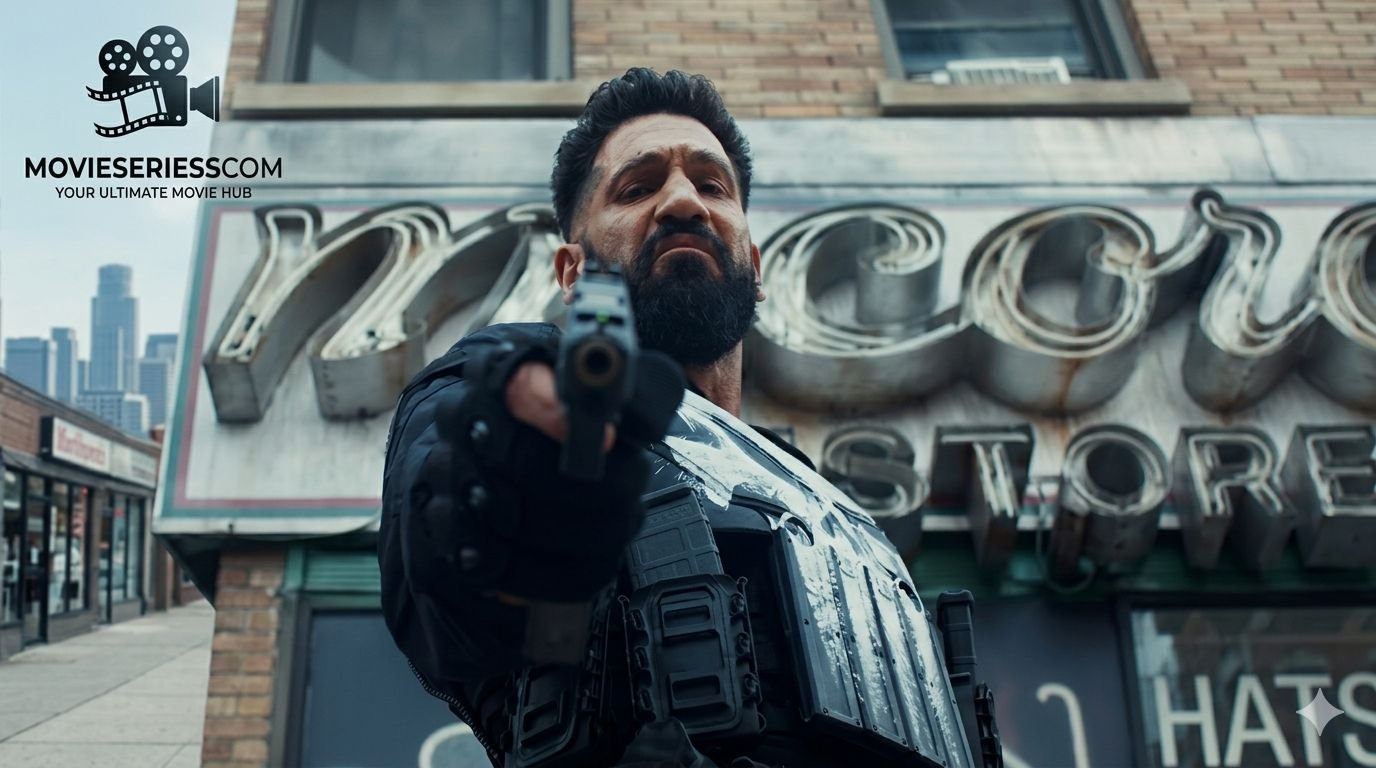
Marvel’s The Punisher: One Last Kill is not a victory lap for Frank Castle. It is a psychological accounting.
The 2026 special takes one of Marvel’s most brutal antiheroes, and puts him at a crossroads rarely explored this deeply on screen. With the Gnucci crime family finally wiped out and the murder of his own family avenged, Frank is left with the question that defines the entire special: what happens when revenge is complete?
Instead of closure, the special doubles down on emptiness, guilt and mental collapse. One Last Kill leaves us with the understanding, by the time the credits roll, that Frank Castle’s war is far from over — and it looks like his road is leading directly into Spider-Man: Brand New Day.
Frank Castle Wins – And That’s the Problem
Most revenge stories are going to catharsis.
One Last Kill, purposely, negates that.
Frank opens the special having already accomplished what he spent years fighting for: the total annihilation of the Gnucci family, the crime syndicate that was responsible for the death of his family. This should be the end of his mission in theory.
Rather it is the beginning of his unravelling.
Unanchored by vengeance, Frank descends into hallucinations of his children and fallen military brothers. These are some of the strongest moments in the special, because they show us something the Punisher rarely lets himself admit: he has no life outside of war.
Jon Bernthal plays this version of Castle with weary, restrained restraint. He is not fueled by rage anymore. It hollows him out.
The true villain of the story is that emotional emptiness.
Gnucci Power Crumbles, New York Descends Into Chaos
What’s clever about the special is that it extends Frank’s internal struggle to show the consequences of his actions.
With the Gnucci family gone, Little Sicily spirals into lawlessness. What ought to be freedom turns into chaos.
Neighborhoods taken over by street gangs. Businesses are robbed in broad daylight. Violence is rewarded.
This establishes one of the more disturbing themes in the special: that removing evil doesn’t necessarily restore order.
The homeless man with his dog in the opening scene establishes the tone right away. It’s cruel, uncomfortable and deliberately over-the-top – not just to shock, but to hammer home just how broken this corner of the city has become.
Frank might have killed the kingpins, but he’d also broken the system that kept the smaller predators in check.
Ma Gnucci becomes Frank’s mirror
The best thing about the special is how it introduces Ma Gnucci as Frank’s new nemesis.
Rather than adding another generic mob boss, the story makes her Castle’s warped reflection.
She has lost her family, like Frank.
She wants revenge, like Frank.
Like Frank, she will unleash destruction to get it.
Dramatic, chilling in its way, because she makes him face up to the uglier truth of his crusade: he has made someone just like himself.
Less revenge, more legacy. When she places a bounty on his head and sends the criminal underbelly of the neighborhood after him.
Frank destroyed one Punisher origin story just to create another.
That parallel adds a lot more emotional complexity to the special than a typical revenge thriller.
Why Frank Doesn’t Murder Ma Gnucci
This is the climax of the end.
Frank goes for it.
Ma Gnucci is exposed, vulnerable, close enough to touch. Normally, this would be the inevitable execution scene that audiences expect.
But he just walks away.
It is not pity.
That’s evolution.
In that instant, Frank sees Charli and her family in imminent peril. He chooses to save innocent lives rather than for personal revenge.
That choice matters because it is a small but important shift in Castle’s mission.
Frank has for years been a machine of retaliation. Here he is a protector, above all.
Later, the paper flower Charli gives him is one of the episode’s most quietly effective emotional beats. It reminds him of his daughter, and it reminds him of the humanity that he has buried for years.
This is not atonement.
Frank Castle is very much still the Punisher.
But it is the first sign that his war could be changing shape.
The Final Kill Explains It All
The special ends with Frank tracking down the thug who killed the homeless man’s dog.
Theoretically, it’s a smaller target than Ma Gnucci.
It’s the perfect story decision.
This last act reaffirms what Frank has become. He’s not only after the people who personally hurt him anymore. He is punishing cruelty wherever he comes across it.
One can hardly miss the symbolism.
The dog’s death was pure senseless brutality – violence for no reason other than someone could.
In killing the man, Frank is saying that his mission has gone beyond revenge.
He’s not battling his history anymore.
He is ruling the city through fear.
That makes him even more dangerous, as Marvel moves into its next chapter.
Is the ending tied into Spider-Man: Brand New Day?
Not really.
Not a post-credits scene. Not a Peter Parker cameo. Not an explicit bridge to Spider-Man: Brand New Day.
But the setup is unmistakable.
The ending leaves Frank as an active force, hunting down the criminal underworld of New York, with Ma Gnucci still alive and a neighborhood war brewing.
This, of course, puts him on a collision course with Spider-Man.
Peter Parker has always been a symbol of restraint, responsibility and hope. Frank Castle is finality. He is punishment. He is moral absolutism.
Trailers featuring Spider-Man preventing Punisher from killing someone hint that Brand New Day will delve into that clash of ideologies.
And after One Last Kill, Frank joins that story more unhinged, more convinced of his mission, than ever.
That’s what makes the match-up interesting.
What It Means for Frank Castle’s Future
The biggest takeaway from One Last Kill is that Marvel is not going soft on Frank Castle.
If anything, the special doubles down on his darkness, but adds psychological depth to it.
The ending indicates that future stories will be less about revenge plots and more about Frank as a brutal self-appointed guardian of New York.
That shift allows for bigger battles with heroes like Spider-Man that fundamentally disagree with Frank’s methods.
It also gives Castle something he hasn’t had in years: forward motion.
His tale is not a looking back for the first time.
It’s about choosing what’s next.
Conclusion
The Punisher: One Last Kill is a dark, introspective and surprisingly thoughtful special for Marvel.
It opts for character study over spectacle, not non-stop action – and that gamble pays off.
The special redefines Frank Castle at a crucial point, revealing that even after revenge is achieved, the war inside him is not over.
It may not have the glitzy MCU connections, but it does something more important: give Frank Castle a compelling new direction.
And if this is the Punisher entering Spider-Man: Brand New Day, then Peter Parker is about to encounter one of his most morally ambiguous enemies yet.